Sunday, March 24, 2013

Family Ties Across the Nation


            This map intrigued me because it shows how transnational our family units really are.  The family diagramed in the map has roots that span the entire width on our country: from California to the Eastern Seaboard. Generation to generation shifts back and forth between many places to suit the needs of that family unit. I know that my family map would be similar to this one, perhaps with a few less crisscrossing connections, but it would certainly span the entire country.
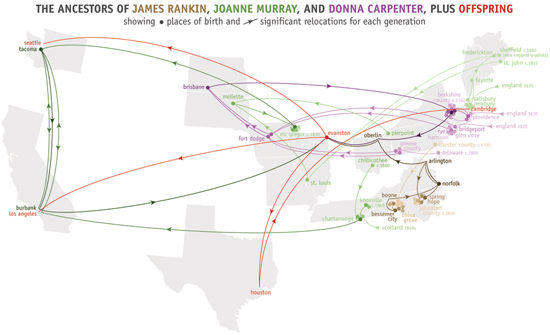
            

            Much of the same is probably true for most family units in the United States. We really do live up to our nickname given back in the 1900s’ of “The Melting Pot”. Not only do we have people living in one area that are from the opposite side of the country but we even have many individuals who are from other places around the globe. In this aspect our family units have expanded from being just transnational to both transnational and transcontinental. Personally, I have a cousin and his family living in Japan while most of my other family is here in the United States.
            This diaspora effect is really due to how the United States does have so many immigrant families. Also, generations of families are constantly in flux and move from place to place. However, I believe an even greater reason for this diverse family unit stems from how modern society puts a type requirement on individuals to be not only respectful but actively participate in various cultures and ethnicities around the world. A perfect example of a uniquely diverse family would be the family in the show “Modern Family” I personally love this show as it is filled with hysterical laughs and offers a good relation point that all families have special, unique quarks. On the show, the family contains some American born members, an adopted child from some place in Asia, and a Mexican heritage mom and son. This family certainly qualifies as a transcontinental family unit.
            More importantly, seeing the map created by Bill Rankin jumpstarted my thoughts into thinking how many of the characters of the novels we have read in class would have complex crisscross maps as well. John Grady’s would extend from Texas to Mexico, Dodd and Laurie’s would extend similarly and Billy the Kid, from what we can definitely pinpoint would start it New York and follow to and surround the New Mexico and Texas area. Each of these characters had created a network of connections from one place to the other, sometimes going back to the same place more than once like John Grady, Dodd and Laurie and sometimes not like Billy the Kid. With the upcoming section on American Indians, I am positive there would be intricate connection networks of where family units have lived and currently live.
            It is fascinating to see how one contained family unit can be so dispersed everywhere.

Rankin, Bill. "The Ancestors of James Rankin, Joanne Murray, and Donna Carpenter,             Plus Offspring." Radical Cartography. N.p.. Web. 19 March 2013. <http://www.radicalcartography.net/>.

Wednesday, March 20, 2013

42


I recently saw the trailer for the move “42” which is the incredible story of Jackie Robinson. Robinson is perhaps the most transcendent border crosser of all time. He crossed into the “white mans” game as the first African American player. As evidenced by the trailer and history he was not welcomed and pitchers threw at him, fans jeered him and even his teammates were unaccepting of this situation. However Robinson persevered and broke the color barrier and became one of the greatest players in baseball history. I think the most revealing quote of the trailer is when Robinson asks Branch Rickey, the owner of the Brooklyn Dodgers, if he wants a man who doesn’t have the guts to fight back to which Rickey replies “I want a man who has the guts not to fight back”. I think this is a very important quote because it shows what it takes to cross the borders of our lives. People are going to go against your decisions and not support the crossing into a new territory of your life. Instead of shying away from these people you need to have the courage to look these people in the eye and not shy away from the challenges. Robinson’s entire career exemplifies this quote and I think it can apply to many of the characters we have studied in class. 

Tuesday, March 19, 2013

What is "Normal"?


    Below are the lyrics to the song, "Love Like Crazy" sung by Lee Brice.  In short, the country tune is about a young couple who fell in love at the age of 17.  Outsiders called them crazy, saying that they were too young to understand what love truly was. Despite how young they are, they defy the age barrier set by society for "the right age to fall in love", remaining together for 58 years and counting. Later in the song, the husband quits his jobs and decides to sell computers instead.  Once again outsiders called him crazy, saying that these computers would never make a name for themselves.  In the end, the man sells his workshop to Microsoft, making enough money to live comfortably for the rest of their lives.  So who was truly the crazy ones?
    This song makes me think about the border between what we consider "normal" and "crazy".  Many people choose to live their lives based on society's norm and by the expectations set by others, even if that means sacrificing their own happiness.  The people in the song disregard the opinions given by others, even though they may have been "crazy".  Yet according to the song, they didn't turn out too bad, did they?  It seems as though, we as citizens of a sometimes cruel society, focus more on what other people think about us, than what we actually think about ourselves.

"Love Like Crazy"

They called them crazy when they started out
Said, "Seventeen's too young to know what loves about"
They've been together fifty-eight years now
That's crazy

He brought home sixty-seven bucks a week
Bought a little 2 bedroom house on Maple Street
Where she blessed him with six more mouths to feed
Now that's crazy

Just ask him how he did it
He'll say, "Pull up a seat
It'll only take a minute
To tell you everything"

Be a best friend, tell the truth
And overuse "I love you"
Go to work, do your best
Don't outsmart your common sense
Never let your prayin' knees get lazy
And love like crazy

They called him crazy when he quit his job
Said them home computers, boy, they'll never take off
Well, he sold his one man shop to Microsoft
And they paid like crazy

Just ask him how he made it
He'll tell you faith and sweat
And the heart of a faithful woman
Who never let him forget

Be a best friend, tell the truth
And overuse "I love you"
Go to work, do your best
Don't outsmart your common sense
Never let your prayin' knees get lazy
And love like crazy

Always treat your woman like a lady
Never get to old to call her baby
Never let your prayin' knees get lazy
And love like crazy

They called him crazy when they started out
They've been together fifty-eight years now
Ain't that crazy?


Love Like Crazy (Official Music Video)-Lee Brice


    This idea about the border between "normal" and "crazy" similarly pertains to my life throughout the past year.  Last year, my freshman year of college, I attended the University of Maryland on a 80% softball scholarship.  As cool as that sounds, I was miserable.  At the end of the year, I knew I had to transfer.  My parent's did not support my decision, due to the minimal amount of money I needed to pay for tuition, because of my scholarship.  I went against their wishes, got my release from my athletic contract and applied to other universities.  The University of Pittsburgh was, by far, my favorite.  Because it was in the middle of the summer, the coaches no longer had any scholarship money left, but gave me the option of a walk-on tryout, with no guarantee of making the team.  I enrolled at Pittsburgh, knowing only two people and signed an apartment lease with girls I had never met. A week after school started, I tried out for the softball team, and actually made it.  Today, I am the starting short stop for our team and so much happier than I ever was at my old school.
    Similar to the couple in "Love Like Crazy", many people, even my parents called me crazy a year ago.  I left a great academic school at Maryland and a large Division 1 program with a pretty big scholarship that many kids can only dream of while growing up.  In exchange, I transferred to a school where I had no idea if I would ever play softball again along with barely knowing a soul.  A year later, I can honestly say that going against the norm of society and despite the opinions of my friends and family, transferring to Pittsburgh has been the best decision of my entire life.  
    During my transferring process and try-out period, I constantly read Steve Job's famous quote in order to reassure my decision.  I hope that it gives you the courage, just like it did with me, to defy the odds set by society and follow your dreams, no matter how "crazy" they may seem.


"Here's to the crazy ones, the misfits, the rebels, the troublemakers, the round pegs in the square holes... the ones who see things differently -- they're not fond of rules... You can quote them, disagree with them, glorify or vilify them, but the only thing you can't do is ignore them because they change things... they push the human race forward, and while some may see them as the crazy ones, we see genius, because the ones who are crazy enough to think that they can change the world, are the ones who do." -Steve Jobs

By: Kaila Balatgek


Monday, March 18, 2013

Dime novels


Hi everyone-- I'm posting this quickly, just to circulate a couple of pictures. Dime novels were formulaic stories that were printed cheaply and in big numbers (and sold for very little money, hence their name). They were extremely popular in the late nineteenth and early twentieth century-- an average newsstand would have tons of dime novels for sale. There were lots of types of stories published as dime novels-- romances, detective stories, stories about extreme adventures in the wilderness, ghost stories-- but the most popular genre by far was the western. The westerns we think of today are mostly in the form of movies-- think of John Wayne (or John Grady) riding off into the sunset, having saved a frontier town from some bad guys-- but the western got its start in dime novels. The fact that the westerns were so, so popular is interesting-- it gives us some sense of just how much the cowboy/outlaw archetypes have influenced American culture.


Once Billy the Kid was killed, he became the topic of many time novels. Newspapers first printed stories about Billy, but it was dime novels that really capitalized on the exciting or romantic elements of his life-- so the Billy the Kid we get in Ondaatje's book is as much a product of fiction as he is of fact. 

I'm posting a couple of pictures of some dime novels (all of which are housed in Pitt's special collections!), just so you can get a sense of how colorful and cartoon-y the covers look. They're about the size of a single issue comic book, and about as thin-- they definitely feel like they were meant to be read and disposed of (consequently, most dime novels that are still around in archives are in pretty bad shape). There's something worth noticing about the juxtaposition of these juvenile books and the pretty violent moment in American history that they're capitalizing on.

See you all tomorrow--
Elizabeth

Railroads breaking borders


This map shows all of the different railroad tracks across the world. At first, I was not going to use this picture because it was hard to tell the detail of the exact number of railroads, but then I decided that viewing this picture at a distance was much more valuable. The red lines (look more like red splotches when viewed from far away) represent the routes that the railroad trains use. When you view this picture from a distance there is an obvious link between developed countries and the number of railroads. The more developed economically the more railroads there are. I think this has to do with the fact that people have more money to spend on travel and have jobs that involve national and international traveling. For example, in the United States there are many more railroads than in less developed countries- like parts of Mexico and South America.

When you look at the United States it is clear that there are more railroad lines in the eastern part of the United States than in the western part of the United States. This could be due to the fact that the eastern part was developed much faster and at an earlier time than the west. It could also be inferred that people in the east travel more or there is a larger population of people in that area.

I also thought that railroads represent a way to cross borders. By traveling from city to city, state to state, or even country to country, you are yourself crossing borders. I think that railroads are a great example of a way to break physical borders. Trains have been around for the greater part of the century, with little changes in the routes that they take. Yes, routes can be added, but the tracks that most trains use were built over a hundred years ago. It is interesting to note that trains are still utilized and have even been adapted to being used in the city. These trains that are used throughout cities nationwide are commonly referred to as subway trains.

I also made a connection between railroad lines and Dodd’s travel from Mexico into the United States in It Came From Del Rio. Dodd walked into Texas from Mexico, but it is interesting to consider that railroads could be used as a way to smuggle things across borders. These borders could be states or countries. Railroads are a much slower way of transportation than planes, but they are known to have much less security. Maybe if Dodd had used a train, he might have been successful in his smuggling effort.


Sunday, March 17, 2013

Nuclear Power

From the selection of radical cartography maps, the one that appealed most interesting to me was the map depicting nuclear explosions around the world. I was particularly interested in this map because I'm fascinated with history and worldwide military events that have occurred in the past. This map really depicts who the world powers have been since 1945 and shows how nuclear technology has shaped the world. Two significant worldwide events where nuclear technology played a part in were World War II and the Cold War.


World War II played a huge role in dividing world power to what it is today. Toward the end of the war, the Nazi regime had ended, but the Pacific campaign to defeat the Japanese seemed to be an ongoing problem. In order to save lives, the United States produced two atom bombs to be dropped on Japan. No only did this end the war, but it saved countless Japanese and American lives. Below is a diagram representing the damage caused by the bomb dropped in Hiroshima, Japan...


The Cold War showed how possessing nuclear weapons gave power to countries over others that didn’t possess this technology. The two major countries involved in the Cold War were the United States and Soviet Union. They constantly competed against each other in numerous ways in order to become the world’s super power. One of these ways of competing was to produce more nuclear weapons than the other. Obtaining more nuclear weapons meant more power over the other. This race to be most powerful in the world has solidified both countries power for the future.


Both of these significant worldwide events involving nuclear technology show how important it is in society today. A good example of a country trying to possess nuclear energy today is Iran. Iran is trying to seek more power through nuclear technology and the United States, for example, does not want them to achieve this.